Why Your Calm Becomes Your Child's Calm
It's 5:45 on a weeknight. Dinner isn't ready, homework is half done, and your child just threw their pencil across the room and burst into tears. You hear yourself say it before you can stop yourself: "Calm down!"
And of course, it doesn't work. If telling kids to calm down worked, parenting would be a lot easier! Well life would be a lot easier. However, think about how you felt the last time your partner told you to calm down, which if you’re like me or many other people it just made you madder. This is also why telling kids to calm down or it’s not a big deal doesn’t work.
If this sounds like you and your family, you are not alone. Big emotions are a normal part of childhood, and they can be exhausting for the entire family. The good news is that how parents respond in those big moments can make an important difference. Kids don't learn to calm down by being told to. They learn it by borrowing calm from the adults around them, over and over, until it becomes their own. Psychologists call this co-regulation.
What Is Co-Regulation?

Co-regulation is the back-and-forth process where a calm, caring adult helps a child manage big feelings until the child can do it on their own. Research on child development (like this practice brief from the Administration for Children and Families) describes parents, teachers, and even coaches as the adults who help kids build these skills.
A few things about co-regulation that often surprise parents:
It comes before self-regulation. Kids learn what calm feels like by being near someone who is calm.
It doesn't end in early childhood. Teens and young adults still benefit from co-regulation (it just looks different for a 15-year-old than a toddler).
It's mostly nonverbal. Your tone, your pace, and your body language often matter more than your words in the hard moment.
It can be learned. Parents can build these skills with practice, and kids benefit when they do.
Why "Calm Down" Doesn't Work
When a child is overwhelmed with anger, worry, or frustration, their body goes into alarm mode. Their heart rate goes up, their muscles tense, and the parts of the brain that help with reasoning and listening take a back seat. That's why the perfectly logical explanation you give in the middle of a meltdown seems to go in one ear and out the other. In that moment, kids usually aren't choosing to ignore you. They just don't have the skills yet to turn the alarm down on their own. What they can do is pick up on how the adult next to them is feeling. A raised voice signals more danger. A slow, steady voice and a relaxed body signal safety.
One of my favorite ways to explain this to parents: your nervous system becomes the model your child's nervous system follows. Repeat that hundreds of times over childhood and your child slowly builds the ability to do it on their own. That is what we call self-regulation.
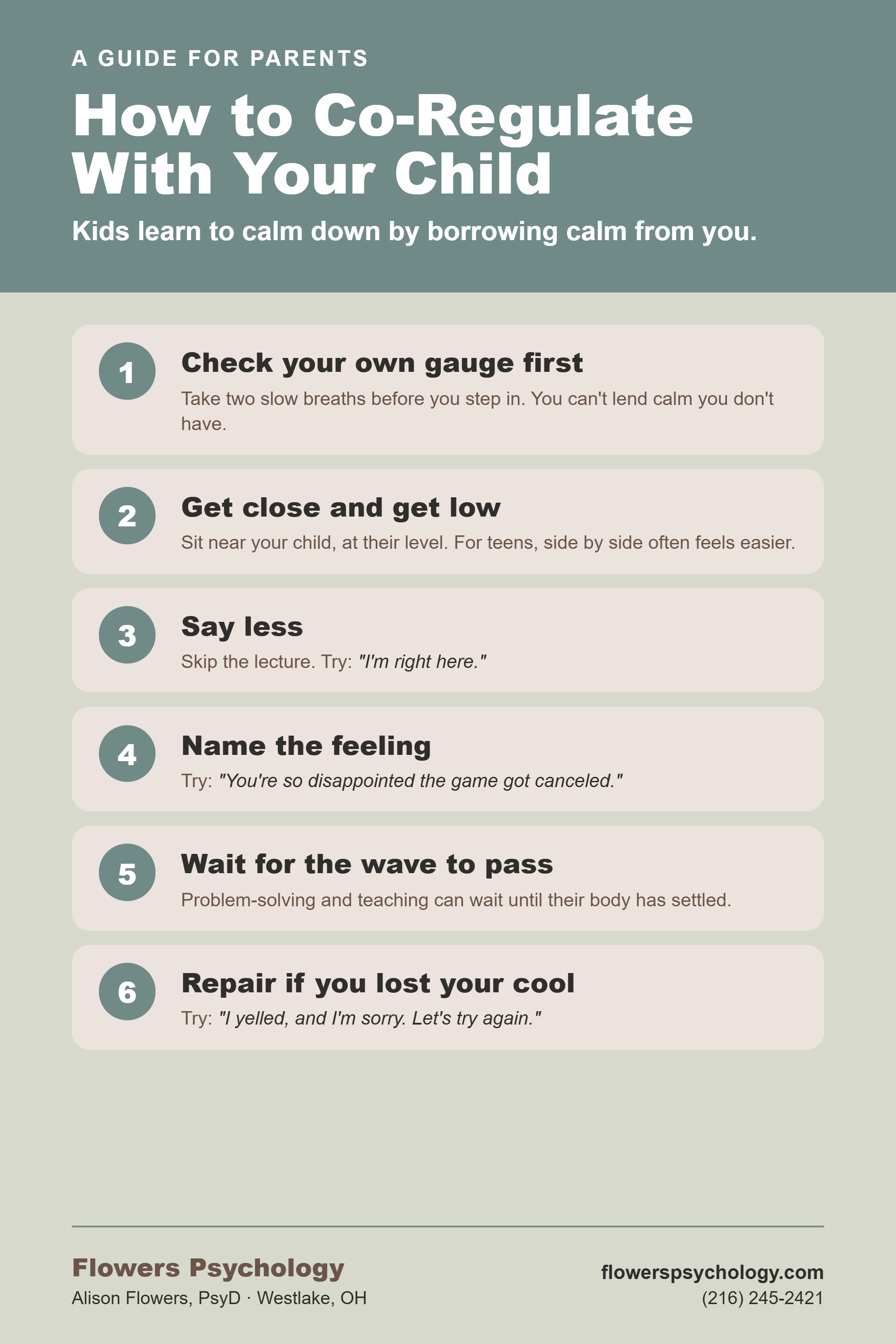
How to Co-Regulate With Your Child
1. Check Your Own Gauge First
Before you step in, notice how you're feeling. If you're at an 8 out of 10, take two slow deep breaths first. It's really hard to lend calm you don't have. One of my favorite metaphors for this is the airplane oxygen mask: put on your own mask first so you can help your child.
2. Get Close and Get Low
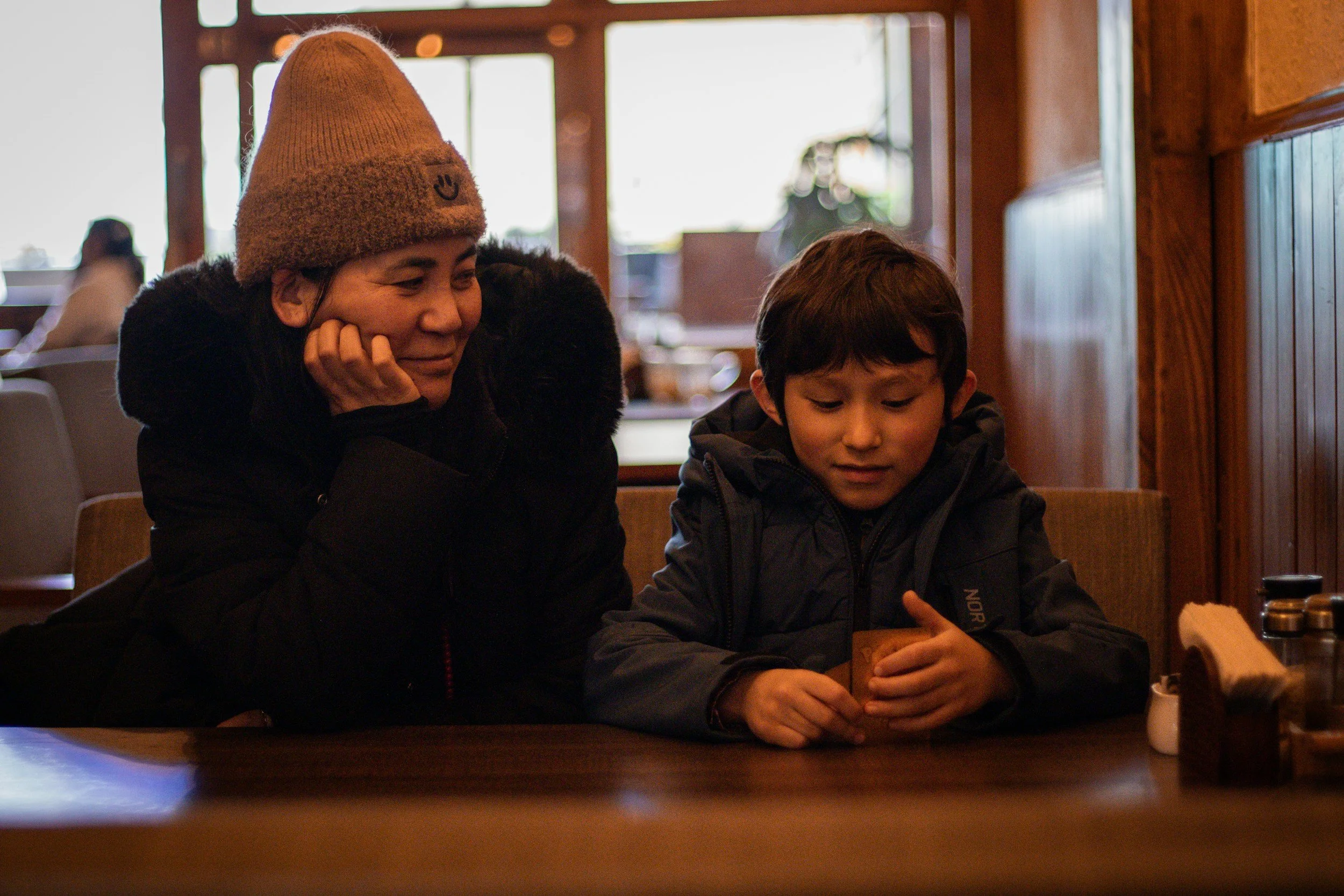
Sit near your child, at their level. For younger kids that might mean sitting right beside them on the floor. For teens, it may mean sitting side by side in the car, going for a walk, or just being in the same room (side-by-side often feels less intense than face-to-face).
3. Say Less
This is usually not the time for a long explanation or a lecture.
Try: "I'm right here." Or: "That's really hard." Then let the quiet do the work.
4. Name the Feeling
Putting a name to what your child is feeling can help bring the intensity down.
Try: "You're so disappointed the game got canceled."
Or: "It sounds like you're really frustrated with that math problem."
5. Wait for the Wave to Pass

Problem-solving, consequences, and teaching moments can wait until your child's body has settled. Once everyone is calm, you can come back to it.
Try: "That was a really hard moment. Let's think about what might help next time."
6. Repair If You Lost Your Cool
I don’t know any parent who hasn’t yelled at their children. When this happens, what matters most is what happens next.
Try: "I yelled earlier, and I'm sorry. I was frustrated, but that wasn't okay. Let's try again."
Repair is co-regulation too, and it shows kids how to recover after a hard moment. This also teaches effective apologies (just don’t stick in a “however” or “but” and lecture them about their behavior).
Your child doesn't need a perfectly calm parent, just a steady enough one to stay close.
What Not to Say (and What to Try Instead)
Even loving, well-intentioned parents fall into these. I see them all the time, and they are all fixable.
Instead of: "Calm down!"
Try: "I'm here. Let's take some deep breaths together."
Instead of: "It's not a big deal."
To your child, it is a big deal right now. Try: "I can see this feels really big."
Instead of jumping straight to fixing it and saying: "Here's what you should do…"
Try acknowledging first: "That's so frustrating." Problem-solving can come later.
Instead of matching their volume, lower yours. It feels unnatural at first, but kids often follow your lead.
Co-Regulation Is Not the Same as Rescuing
This is important, especially for anxious kids. Co-regulation means helping your child feel safe enough to get through something hard. It does not mean removing every hard thing. If they always skip the homework, the drop-off, or the sleepover to avoid distress, kids miss the chance to learn they can handle it.
Instead, try a supportive statement that combines acceptance and confidence: "I know this is hard, and I know you can do it." This is a core idea in SPACE, an evidence-based program for childhood anxiety that I use with parents.
Co-Regulation on Screen: A Ted Lasso Example

If you're a Ted Lasso fan (I am!), Season 4, Episode 8 has a great example of co-regulation. Warning if you haven’t watched this episode yet, what comes next is kind of a spoiler.
After an upsetting setback for the team, Alice is distraught. Ted doesn't try to talk her out of it, cheer her up, or fix the problem. Instead, he sits next to her without saying a word. His calm, steady presence gives her something to lean on until the wave of emotion passes. That's co-regulation: no lecture, no rushing, just being there.
Later, Ted tells his team that there is crying in football: "You don't have to hide or apologize or be ashamed of what you feel."
The first scene shows co-regulation in the moment. The second shows the kind of environment that makes it possible. Kids are much more likely to come to us for help calming down when they already know their feelings won't get them teased, punished, or rushed.
When Big Emotions May Be a Sign Your Child Needs More Support
Everyone has hard moments. Occasional meltdowns in a child are different from an ongoing pattern.
Consider reaching out for professional support if your child:
Has frequent or intense meltdowns
Has meltdowns that are getting worse over time
Struggles to calm down even with your support
Is having big emotions that are interfering with school, friendships, or family life
Seems anxious, irritable, or not like themselves
Has trouble with focus, impulsivity, or following through (sometimes big emotions are part of ADHD, anxiety, or a learning difference)
Final Thoughts
Co-regulation doesn't have to be perfect to work. You don't need the right words every time, and you will lose your cool sometimes (we all do!). What matters most is showing up, staying close, and coming back to repair when things go sideways. Over time, your calm really does become your child's calm.
If meltdowns, anxiety, or power struggles are taking over your family time, working with a child psychologist or therapist can help. I work closely with parents and use evidence-based approaches like PCIT and parent training and SPACE to help families feel calmer and more connected. If you would like more help or guidance feel free to visit my website to learn more about me, or call me at (216) 245-2421 for a free 15-minute phone consultation to see if I'd be the right fit to help. I'd be happy to hear about what is going on and if I'm not the best fit I'm happy to point you in the right direction!